Trump: ‘We Are Going to Run’ Venezuela
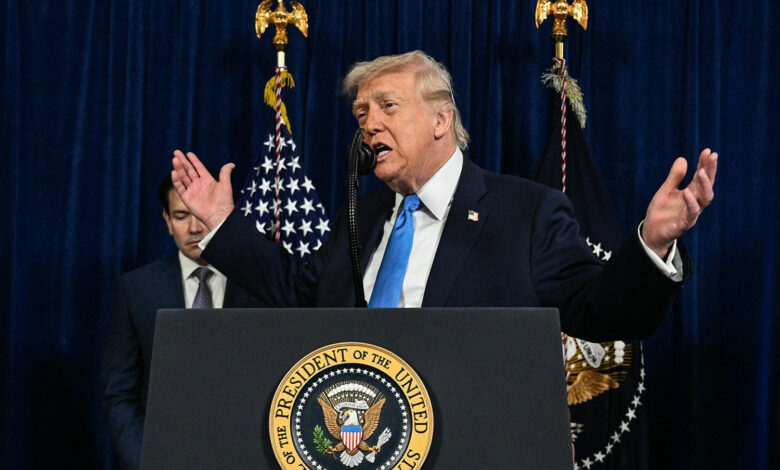
New York – Free Yemen Eye /l- From News -FP
A dramatic operation in Caracas leads to the capture of President Nicolás Maduro with the country’s fate uncertain.
U.S. President Donald Trump on Saturday announced that the United States would “run” Venezuela following an extraordinary U.S. operation that resulted in the capture of Venezuelan President Nicolás Maduro and his wife, Cilia Flores.
“We are going to run the country until such time as we can do a safe, proper, and judicious transition,” Trump, flanked by top cabinet officials, said in televised remarks from his Mar-a-Lago resort in Florida. “We can’t take a chance that somebody else takes over Venezuela that doesn’t have the good of the Venezuelan people in mind.”
It’s unclear precisely how the United States intends to “run” Venezuela and whether that could involve a prolonged military occupation. Trump offered vague details on this, suggesting that he would designate people to oversee the process—signaling that U.S. officials would be directly involved.
The president said it was his understanding that Venezuelan Vice President Delcy Rodríguez was just sworn in as Maduro’s replacement. Trump said U.S. Secretary of State Marco Rubio spoke with Rodríguez and that she’s ready to work with the United States. Reports on Saturday suggested that Rodríguez was in Russia, but the Russian government denied this.
Trump also did not rule out having boots on the ground in Venezuela and suggested that the United States could be involved in running the country for years. “We’re not afraid of boots on the ground. … We had boots on the ground last night,” Trump said.
The president lauded the operation that resulted in Maduro’s capture as one of the “most stunning, effective, and powerful displays of American military might” in history. Trump said no U.S. troops were killed and no military equipment was lost. The chairman of the U.S. Joint Chiefs of Staff, Gen. Dan Caine, said the operation involved 150 aircraft launched from 20 different bases.
Trump also signaled that the White House could potentially order further military actions in Venezuela, sending a warning to Maduro’s allies who remain in the country. “All political and military figures in Venezuela should understand what happened to Maduro can happen to them,” he said.
The president also indicated that the United States would be assuming control of Venezuela’s oil industry. “We’re going to have our very large United States oil companies—the biggest anywhere in the world—go in, spend billions of dollars, fix the badly broken infrastructure, the oil infrastructure, and start making money for the country,” Trump said.
“We’re going to run the country right. … It’s going to make a lot of money,” Trump said.
Speaking after Trump, U.S. Defense Secretary Pete Hegseth said Maduro “effed around and he found out.” Hegseth said the operation represented “America First” and “peace through strength.”
TRUMP INITIALLY ANNOUNCED THE OPERATIONin a social media post on Truth Social, stating that Maduro and his wife had been “captured and flown out of the Country” after a “large scale strike” that was executed in “conjunction with U.S. Law Enforcement.” Trump’s post came hours after a series of explosions were reported at military bases in Venezuela’s capital of Caracas overnight between Friday and Saturday. The Venezuelan government said in a statement that strikes also took place in three other states across the country.
The Trump administration has been ratcheting up its military campaign against Venezuela and Maduro for months, moving thousands of troops and several ships off the country’s coast and conducting multiple strikes on boats that it claimed were being used by drug traffickers—without offering hard evidence to back up its assertions.
Venezuelan Defense Minister Vladimir Padrino López denounced what he described as the “most criminal military aggression” by the United States.
The presence of these international troops that are sowing death, grief, and destruction … is responding to the greed for our natural resources,” López said in a public address shortly after the strikes. “They have spread false lies about narcoterrorism, and they are seeking regime change at the hands of U.S. imperialism.”
Colombian President Gustavo Petro, who has clashedwith Trump repeatedly, wrote on X that he would deploy forces to his country’s border with Venezuela to prepare for a potential influx of refugees. “The government of Colombia rejects the aggression against the sovereignty of Venezuela and of Latin America,” he added.
Meanwhile, Argentine President Javier Milei—a staunch Trump supporter—posted a video of himself previously expressing support for U.S. actions in Venezuela with the Spanish caption: “Long live freedom, damn it.”
Though Maduro was viewed across the world as an illegitimate dictator, the international community is also raising serious concerns about the U.S. operation to capture and depose the Venezuelan president.
“These developments constitute a dangerous precedent,” Stéphane Dujarric, a spokesperson for United Nations chief António Guterres, said in a statement. “The Secretary-General continues to emphasize the importance of full respect—by all—of international law, including the UN Charter. He’s deeply concerned that the rules of international law have not been respected.”
There are also open questions about what happens next and who will lead Venezuela moving forward. When asked whether he would back María Corina Machado, Venezuela’s opposition leader, to be the next president of the South American country, Trump told Fox and Friends, “We’re going to have to look at it.”
Venezuela is home to the world’s largest proven oil reserves, and many in Washington have suggested that a desire for control of these resources has driven the U.S. military actions taken against the country. “It’s not about drugs. If it was, Trump wouldn’t have pardoned one of the largest narco traffickers in the world last month,” Democratic Rep. Alexandria Ocasio-Cortez said Saturday in a post on X, alluding to Trump’s controversial decision to pardon the ex-president of Honduras, Juan Orlando Hernández, who was convicted of drug crimes. “It’s about oil and regime change,” Ocasio-Cortez said.
Some in the Trump administration denied that Maduro’s capture and removal from Venezuela constituted regime change. “This is not regime change this is justice,” Mike Waltz, the U.S. ambassador to the U.N., said in a post on X.
There are also open questions about what message the operation sends to other U.S. adversaries, including those aligned with Maduro, such as Cuba, as well as the potential for further military actions or strikes in Latin America. “I think Cuba is going to be something we’ll end up talking about because Cuba is a failing nation. … It’s very similar,” Trump said during his press conference at Mar-a-Lago. Trump also said Colombia’s Petro, whom he has baselessly referred to as an “illegal drug leader,” needs to “watch his ass.”
And during his interview with Fox and Friendsearlier in the day, Trump signaled that the United States could potentially take actions against drug cartels in Mexico. “The cartels are running Mexico,” Trump said. “Something is going to have to be done with Mexico.”
WHEN CONGRESS REOPENS ON MONDAY, lawmakers will likely pose difficult questions about why they were kept out of the loop about the dramatic weekend operation. Republican Sen. Mike Lee initially questioned Trump’s authority to order Saturday’s strikes. “I look forward to learning what, if anything, might constitutionally justify this action in the absence of a declaration of war or authorization for the use of military force,” he wrote in a post on X. Lee subsequently posted that he had spoken with U.S. Secretary of State Marco Rubio, who informed him that Maduro had “been arrested by U.S. personnel to stand trial on criminal charges in the United States, and that the kinetic action we saw tonight was deployed to protect and defend those executing the arrest warrant.”
The U.S. Justice Department had charged Maduro with alleged drug trafficking and corruption in March 2020, during Trump’s first term in office, accusing the Venezuelan president of conspiring to “flood the United States with cocaine.” The Trump administration has signaled that Maduro and his wife will face prosecution in the United States. U.S. Attorney General Pamela Bondi said on Saturday in a post on X that “Maduro and his wife, Cilia Flores, have been indicted in the Southern District of New York” and “will soon face the full wrath of American justice on American soil in American courts.”
The operation to capture Maduro is among the most stunning and controversial steps the United States has taken against a foreign leader in decades. The move adds to the long and painful history of U.S. interventions in Latin America and was conducted without the authorization of Congress or the U.N. Security Council.
Along these lines, a number of Democratic lawmakers have questioned the legality of the operation that resulted in Maduro’s capture. House Minority Leader Hakeem Jeffries in a statement saidthe Trump administration “has not sought congressional authorization for the use of military force and has failed to properly notify Congress in advance of the operation in Venezuela.”
Similarly, Democratic Rep. Jim Himes, the ranking member on the House Intelligence Committee, in a statement said, “Maduro is an illegitimate ruler, but I have seen no evidence that his presidency poses a threat that would justify military action without Congressional authorization.”
Trump told Fox and Friends that lawmakers criticizing him for taking action without congressional approval were “weak, stupid people.” While the U.S. Constitution grants the president broad powers when it comes to the use of military force, only Congress has the authority to declare war. While Trump and others in his administration have claimed that the United States is at war with “narcoterrorists,” Congress has made no such declaration.